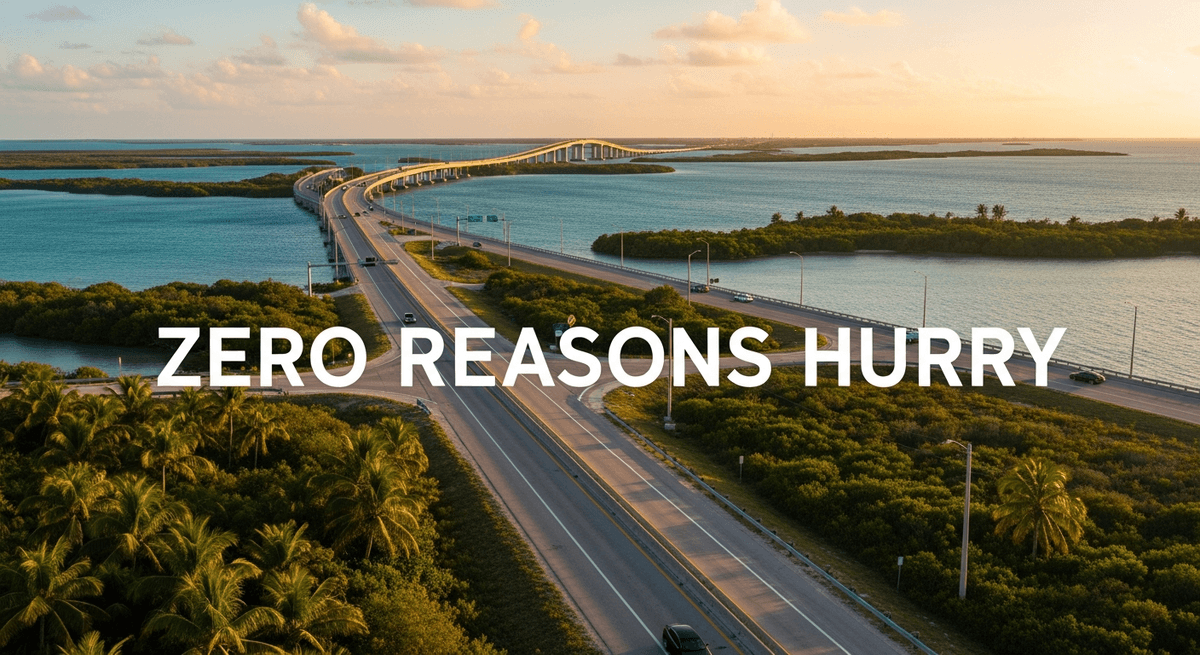

The Florida Keys road trip operates on a principle that the rest of the American road trip tradition has largely failed to grasp, which is that a road is at its most effective when it runs, where possible, directly over the ocean. The Overseas Highway, US Route 1 from Florida City to Key West, spans 113 miles and 42 bridges, threading through a chain of coral islands with the casual confidence of a route that knows it has no real competition. One cannot help but feel that whoever designed this stretch of highway understood something essential about the relationship between automobiles and water, and decided to push the concept as far as physics would allow.
The effect, particularly at the Seven Mile Bridge between Marathon and the Lower Keys, is of driving into the Gulf of Mexico with no particular intention of stopping, the water extending on both sides to a horizon that seems, in the midday light, to have been coloured by someone who felt that ordinary blue was insufficiently dramatic. It is a road trip that unfolds like a particularly well choreographed daydream, where each mile marker brings one further from the sensible world of traffic lights and strip malls, and closer to something that resembles paradise but with better infrastructure and more reliable air conditioning.
The Route: 113 Miles of Liquid Logic
The Florida Keys road trip follows US Route 1 from Florida City to Key West, a journey of 113 miles that requires approximately two and a half hours if driven directly, though doing so would demonstrate a fundamental misunderstanding of the Keys' entire philosophy. The drive crosses 42 bridges, including the famous Seven Mile Bridge, and connects a chain of coral islands that stretch southwest into the Gulf of Mexico like a string of pearls that decided to go for a swim.
The best time for this road trip runs from December through April, when temperatures hover in the comfortable seventies and humidity has not yet reached the levels that make one question life choices. Summer brings heat that settles over the islands like a warm, damp blanket and hurricane season, which the locals discuss with the resigned familiarity of people who have made peace with living in a particularly beautiful target zone. Spring break should be avoided unless one finds crowds of college students charming, which most seasoned travelers do not.
Distance markers in the Keys count down from Florida City, beginning at mile marker 126 and reaching zero at Key West, creating the pleasant sensation of counting down to something magnificent. The drive can be completed in a single day, but this would be rather like visiting the Louvre at a sprint, technically possible but missing the point entirely.
Key Largo: The Gateway with Character
Key Largo announces itself with the understated confidence of an island that has been receiving visitors since before Florida tourism became a science. This is the largest of the Keys, stretching thirty miles and offering the John Pennekamp Coral Reef State Park, which holds the distinction of being America's first underwater state park. The park encompasses 70 nautical square miles of coral reefs, seagrass beds, and mangrove swamps, creating snorkeling opportunities that cause visitors to immediately recalculate their vacation budgets.
The glass bottom boat tours operate with the reliability of a well oiled machine, offering glimpses of the underwater world for those who prefer their marine life viewing to remain dry. The underwater statue of Christ of the Abyss, submerged in 25 feet of water, creates one of those experiences that sounds rather more peculiar in description than it proves in reality. Diving to visit the statue has become something of a pilgrimage for underwater enthusiasts, who surface speaking in the reverent tones typically reserved for cathedrals.
The Alabama Jack's restaurant, technically on Card Sound Road rather than in Key Largo proper, serves conch fritters and beer with the casual excellence of a place that has never needed to advertise. The establishment sits on stilts over the water, offering views of the mangroves and the sort of atmosphere that suggests time moves differently here, if it bothers to move at all.
For accommodation, the Hawks Cay Resort provides luxury amenities including a dolphin encounter program, while the John Pennekamp State Park offers camping for those who prefer their lodging to come with a side of adventure. The Caribbean Club, where Humphrey Bogart filmed scenes for the 1948 movie "Key Largo," still operates as a bar and provides the sort of authentic atmosphere that modern establishments spend fortunes trying to recreate.
Islamorada: Where Fishing Becomes Art
Islamorada occupies a stretch of the Upper Keys with the proprietary air of a place that knows it does one thing extraordinarily well and has decided that is sufficient. The self proclaimed "Sportfishing Capital of the World" backs up this claim with charter boats that dot the marina like a fleet preparing for a very civilized invasion. The fishing here is of the variety that appears in magazines and causes otherwise rational people to wake at four in the morning and spend money they had not budgeted for on the chance of landing a tarpon that weighs more than their luggage.
The Theater of the Sea, established in 1946, offers encounters with dolphins, sea lions, and stingrays that operate on the principle that education and entertainment need not be mutually exclusive. The facility sprawls across a natural saltwater lagoon, creating an environment where marine mammals appear to enjoy themselves as much as the visitors do. Swimming with dolphins here avoids the overcrowded circus atmosphere that plagues some similar attractions, maintaining instead the intimate scale of a place that remembers when such experiences were rare.
Anne's Beach stretches along the Atlantic side of Lower Matecumbe Key, offering a quarter mile of sandy shoreline with the sort of clear, shallow water that makes snorkeling accessible to nervous beginners. The beach includes a boardwalk that extends into the mangroves, creating viewing opportunities for the sort of bird life that operates like a live nature documentary. Parking is free, restrooms are clean, and the whole enterprise functions with the efficient simplicity of a place that has not overthought its appeal.
Dining in Islamorada centers around seafood prepared by people who understand that excellent ingredients require little improvement. The Hungry Tarpon serves stone crab claws and key lime pie with the confidence of a restaurant that has never needed to justify its methods, while Lorelei Restaurant and Cabana Bar offers outdoor seating where sunset viewing comes complimentary with every meal.
Marathon: The Practical Paradise
Plan this route with GPSSquad
AI powered itineraries, expense splitting, and group coordination in one app.
Start Planning FreeMarathon serves as the practical heart of the Florida Keys, positioned at the midpoint with the businesslike efficiency of a town that understands its role in the larger narrative. It provides the grocery stores, gas stations, and hardware outlets that keep island life functioning, while somehow managing to maintain the laid back atmosphere that draws people to the Keys in the first place. This balance between utility and charm operates like a well rehearsed magic trick, where the mechanics remain invisible and the effect appears effortless.
The Turtle Hospital occupies a converted motel and operates with the cheerful dedication of an institution that has found its calling in the rehabilitation of injured sea turtles. Tours run daily, offering visitors the chance to meet turtles recovering from boat strikes, fishing line entanglements, and various other encounters with human civilization. The facility treats its patients with the sort of professional care typically reserved for much larger mammals, and the staff discusses turtle personalities with the fondness of people who genuinely enjoy their work.
Sombrero Beach stretches along the Atlantic side of Marathon, offering what many consider the finest public beach in the Keys. The sand is imported but the setting is authentic, with coconut palms providing shade and clear water extending far enough from shore that wading becomes a prolonged activity. Picnic tables, grills, and restrooms make this an ideal spot for families, while the gentle waves create swimming conditions that nervous parents appreciate.
Crane Point Museum and Nature Center encompasses 63 acres of native Florida Keys habitat, including a butterfly conservatory and the Museum of Natural History of the Florida Keys. Walking trails wind through hardwood hammocks where wildlife viewing requires patience but delivers rewards that justify the effort. The Wild Bird Center rehabilitates injured birds, creating opportunities to observe species that typically remain hidden in the mangroves.
The Seven Mile Bridge: Engineering Meets Poetry
The Seven Mile Bridge departs Marathon headed southwest and proceeds, for 6.79 miles (the name employs a certain poetic license), over open water with the sort of confidence that suggests its engineers understood they were creating something more significant than mere transportation infrastructure. The drive across it unfolds like a meditation on the relationship between human ambition and natural beauty, where the audacity of building a highway across the ocean somehow enhances rather than diminishes the surrounding seascape.
The old bridge runs parallel to the new one, its abandoned spans creating a ghost highway that photographers find irresistible and fishing enthusiasts have claimed as their own. Built in the early 1980s, the current bridge rises high enough to allow boat traffic to pass beneath, creating moments during the crossing when one feels suspended not just above the water but somehow outside the normal rules of terrestrial travel. The views extend in all directions to horizons that seem impossibly distant, as if the bridge has transported drivers into the sort of maritime painting that decorates upscale seafood restaurants.
Pigeon Key, accessible from the old bridge via a walking path or ferry, offers a glimpse into the construction history of the original railway that Henry Flagler built to connect the Keys to the mainland. The restored buildings and museum chronicle the engineering challenges of building across water in an era when such projects qualified as genuine adventures. The island maintains the peaceful atmosphere of a place where history feels immediate rather than academic, and the views back toward the bridge provide perspective on the achievement that modern drivers take for granted.
Key West: The Inevitable, Irresistible Conclusion
Key West has been many things throughout its history: pirate haven, wrecking capital, cigar manufacturing center, Navy base, and Hemingway's chosen habitat. It has arrived at its current incarnation as a place where Duval Street operates on the reasonable assumption that it is permanently Saturday evening and sees no evidence to the contrary. This transformation might trouble purists, but Key West has always been a place that reinvented itself according to economic necessity, and tourism proves considerably more sustainable than most of its previous occupations.
The Ernest Hemingway House and Museum draws visitors who come for the literary history and stay for the six toed cats, descendants of Hemingway's original polydactyl feline, Snow White. The cats roam the property with the proprietary air of animals who understand they are the main attraction, and their presence transforms what might otherwise be a standard house tour into something more engaging. The writing studio where Hemingway produced some of his most famous works overlooks grounds that maintain the tropical abundance the author preferred, creating an environment where creativity seems both possible and inevitable.
Mallory Square hosts the nightly sunset celebration, a ritual that transforms the western edge of the island into an outdoor theater where street performers, musicians, and vendors create a carnival atmosphere that somehow enhances rather than diminishes the natural spectacle. The sun descends into the Gulf of Mexico with the theatrical deliberateness of a performer who knows the audience is watching, and the crowd responds with applause that seems both ironic and sincere, a combination that captures something essential about Key West's character.
The Conch Republic mythology permeates the island, celebrating the 1982 mock secession from the United States that began as a publicity stunt and evolved into a permanent attitude. Key West embraces its status as a place apart, where normal rules apply with considerable flexibility and eccentricity is not just tolerated but actively encouraged. This atmosphere creates the sort of vacation experience that feels transformative rather than merely pleasant, where visitors return home with stories that sound improbable but are entirely accurate.
Practical Planning for Paradise
The Florida Keys road trip operates most smoothly with advance accommodation reservations, particularly during the winter high season when rooms command prices that would make Manhattan hotel managers envious. Budget travelers should consider camping at John Pennekamp State Park or staying in Marathon, where rates remain more reasonable and the drive to Key West takes less than an hour. Mid range options include the numerous waterfront motels that dot the islands, many offering fishing charters and dive services that justify their premium locations.
Packing for the Keys requires consideration of the marine environment and subtropical climate. Reef safe sunscreen is essential and often legally required, as traditional sunscreens damage coral reefs that are already under considerable stress. Waterproof phone cases, snorkeling gear, and quick dry clothing prove invaluable for travelers who plan to spend time in and around the water. A light jacket serves for air conditioned restaurants and the occasional winter cold front that can drop temperatures into the sixties, which locals consider practically arctic.
The Florida Keys road trip has no natural ending point because Key West resists conclusion, operating instead as a place where time stretches like warm taffy and departure feels like an admission of defeat. This is a road trip that unfolds according to its own logic, where the journey proves as compelling as the destination and the miles between bridges offer their own rewards. Unlike other American classics such as Route 66 or the Pacific Coast Highway, the Keys offer the unique experience of driving over water toward an island paradise. While the Blue Ridge Parkway may claim autumn beauty and Glacier National Park boasts mountain majesty, no other American road trip delivers the sensation of floating above crystal clear water toward the sunset celebration at Mallory Square, leaving you free to focus on the genuinely pressing question of which tiki bar offers the most authentic rum punch and the clearest view of paradise.