
There are destinations that wear their magnificence lightly, like a well tailored coat that happens to be made of cloth of gold, and then there is Rajasthan, which approaches the business of being spectacular with the methodical thoroughness of a maharaja planning a wedding. This is a state where the very concept of understatement packed its bags centuries ago and departed for quieter regions, leaving behind cities that announce their identities through colour schemes as if they were competing in some vast architectural costume party.
The rajasthan road trip unfolds like a royal progress through a landscape that has been arranging itself for maximum visual impact since the Rajput kingdoms decided that military surplus was best invested in buildings that would make visitors weak at the knees. From Delhi's urban sprawl to the pink battlements of Jaipur, through the blue maze of Jodhpur to the golden mirage of Jaisalmer, before culminating in Udaipur's white marble reverie beside its shimmering lakes, this route covers 1,800 kilometres of terrain that treats subtlety like a communicable disease and splendour like a family heirloom to be displayed at every opportunity.
The Royal Route: A Circuit of Colour and Grandeur
The classic rajasthan road trip follows a circuit that reads like a roll call of India's most photogenic destinations: Delhi to Jaipur (280 km, 4 hours), Jaipur to Jodhpur (340 km, 5.5 hours), Jodhpur to Jaisalmer (290 km, 4.5 hours), then the southern sweep to Udaipur (550 km from Jaisalmer, 8 hours with stops in Jodhpur). The full circuit demands a minimum of twelve days to avoid the rushed tourism that turns palaces into mere photograph opportunities, though three weeks allows for the leisurely appreciation that Rajput architecture deserves. For those seeking different landscapes after experiencing the desert splendour, Kerala's backwaters and spice estates offer a completely contrasting journey through India's tropical south.
The optimal season runs from October through March, when the desert heat retreats to tolerable levels and the marble palaces become places of refuge rather than furnaces. Winter mornings in Jaisalmer can be crisp enough to require layers, while afternoons remain warm enough for comfortable palace exploration. The monsoon season, July through September, transforms the landscape into something greener but renders desert camping inadvisable and some routes temporarily impassable.
Jaipur: The Pink City That Means Business
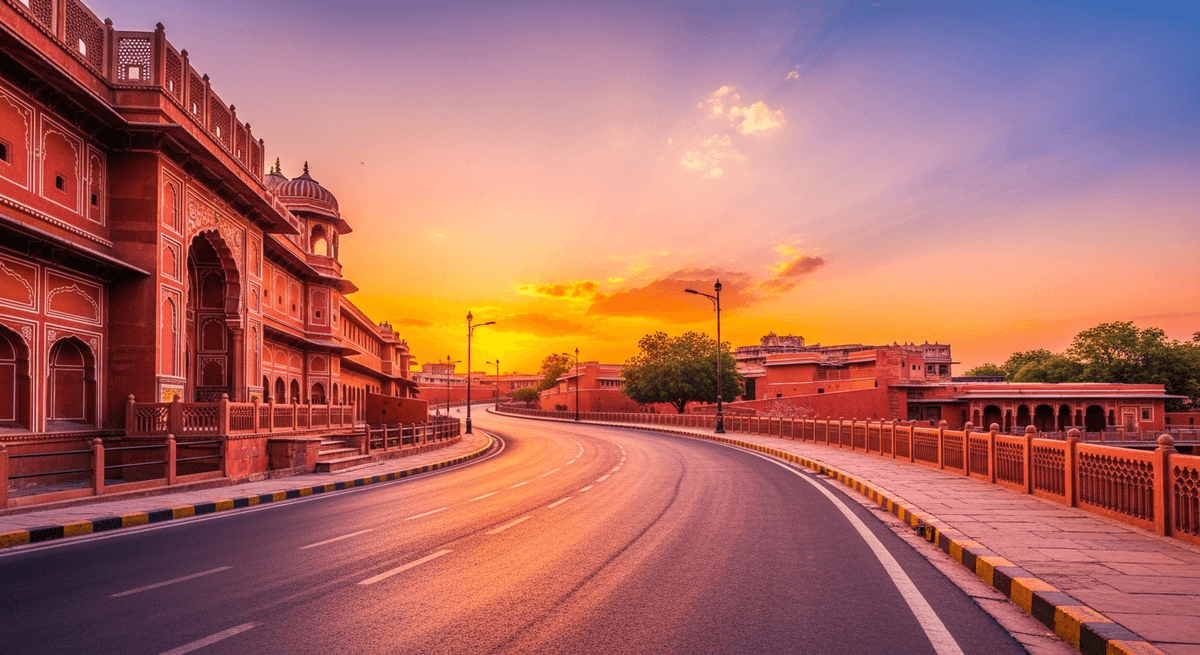
Jaipur announces itself through a colour scheme that would be presumptuous if it were not so thoroughly successful. The old city was painted terracotta pink in 1876 for the visit of Prince Albert Edward, and the colour, having been applied with such satisfactory results, was maintained by municipal ordinance with the dedication of a city that recognises when it has achieved something worth preserving. The effect, particularly on the Hawa Mahal with its 953 small windows arranged in a five storey facade like honeycomb carved from sunset, is of urban planning that treats aesthetic impact as seriously as traffic flow.
The Amber Fort, perched 11 kilometres from the city centre on a hilltop above Maota Lake, demonstrates the sort of architectural confidence that comes from having a century to get things right. Built between 1592 and 1667 by Raja Man Singh I and his successors, it sprawls across the ridge with the composed authority of a fortress that was designed to impress visitors before defeating them. The approach by elephant, available for those willing to embrace the full maharaja experience, provides the intended effect of ascending to a palace that grows more magnificent with each terrace.
Inside, the Sheesh Mahal mirrors every flicker of light like a jewellery box designed by someone with access to unlimited resources and a firm belief that more is more. The evening sound and light show, projected onto the fort's sandstone walls, provides historical context delivered with the dramatic flair that Rajasthani storytelling demands. The City Palace in Jaipur proper houses museums that display the possessions of rulers who collected art, weapons, and textiles with the systematic thoroughness of people who considered magnificence a professional requirement.
For dining, 1135 AD at Amber Fort transforms royal quarters into a restaurant where the view over Maota Lake accompanies Rajasthani cuisine served in rooms where maharajas once held court. In the city, Peacock Rooftop Restaurant provides palace views alongside traditional dal baati churma and laal maas that locals approve of, which in Jaipur constitutes restaurant criticism of the most exacting sort.
Jodhpur: The Blue City and Its Towering Fort
Jodhpur rises from the Thar Desert's edge with Mehrangarh Fort commanding its skyline like a stone crown that grew too large for any single head. This fort, one of the largest in India, rises 122 metres above the city on perpendicular cliffs, its walls six metres thick and designed by builders who approached the concept of impregnability as both practical necessity and artistic challenge. The ascent through seven gates, each marked by battle scars and architectural flourishes in equal measure, builds anticipation like a carefully constructed symphony approaching its crescendo.
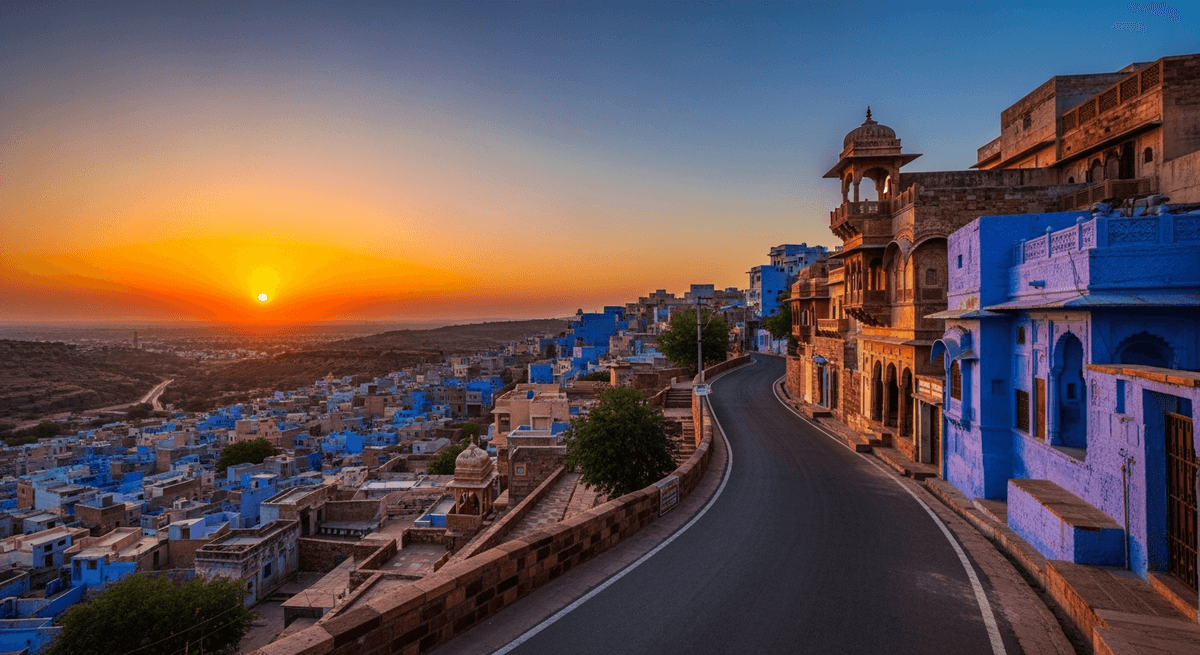
Below the fort, the old city spreads in a maze of blue painted houses, their indigo walls creating a carpet of colour that transforms viewing platforms into experiences of urban landscape as artistic composition. The blue tradition, attributed variously to Brahmin caste identification, insect repellent properties, and simple aesthetic preference, continues with the stubborn persistence of local customs that have survived because they work, regardless of their original reasoning.
Within Mehrangarh's walls, the palace apartments demonstrate why Jodhpur's rulers required such substantial fortifications to protect their accumulated treasures. The Moti Mahal, inlaid with mirror work that catches desert sunlight and multiplies it into constellations, houses a collection of royal cradles that suggests child rearing conducted at the level of state ceremony. The Phool Mahal, the flower palace, presents walls painted with gold leaf in patterns as intricate as Persian carpets, while the Sheesh Mahal continues Rajasthan's apparent belief that no surface should remain undecorated if mirrors are available.
The fort's museum displays howdahs, palanquins, and folk instruments alongside weapons and armour that belonged to rulers who faced the Mughal armies and lived to commission victory celebrations. The ramparts provide views across the blue city that extend to the horizon where desert meets sky in a line as straight as a ruler's decree. For sustenance, the fort's restaurant serves traditional Marwari cuisine while visitors contemplate the logistics of defending such a position against besiegers who lacked the advantage of internal catering.
Plan this route with GPSSquad
AI powered itineraries, expense splitting, and group coordination in one app.
Start Planning FreeJaisalmer: The Golden Mirage
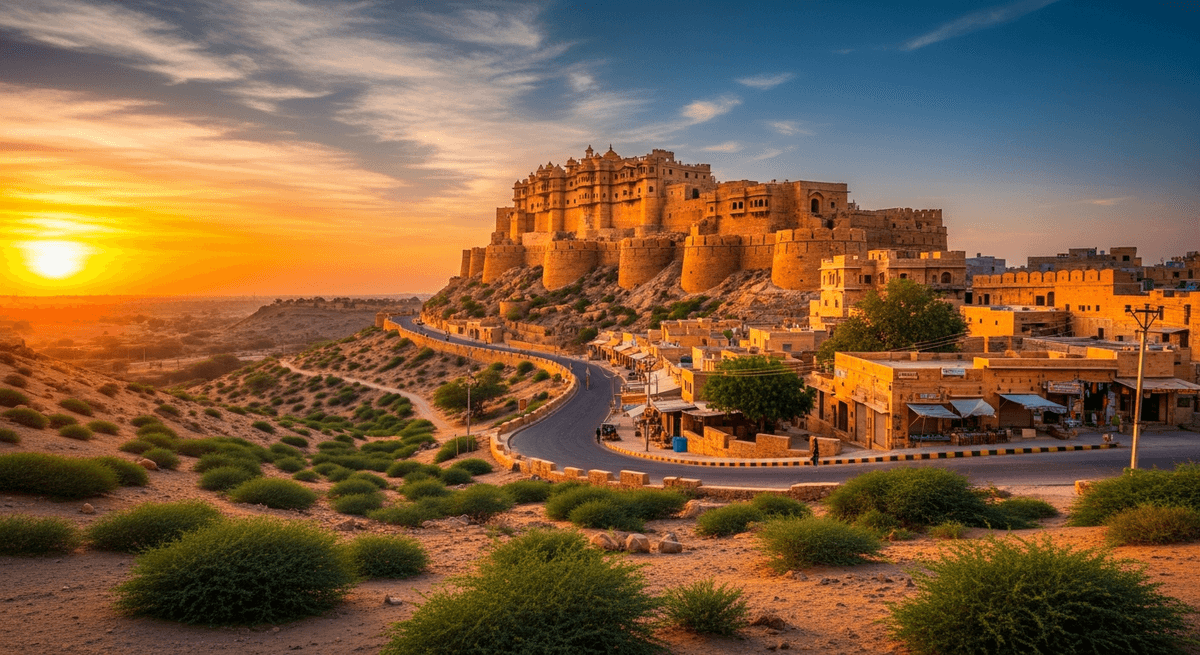
Jaisalmer materialises from the Thar Desert like a mirage that decided to become permanent, its golden sandstone walls rising from sand dunes with the architectural confidence of a city that knows it occupies the exact spot where the caravan routes required a fortress and the desert provided the perfect building material. This living fort, inhabited continuously for over 800 years, houses 3,000 residents within walls where Jain temples, havelis, and ordinary houses create a vertical city that functions as both historical monument and thriving community.
The approach to Jaisalmer Fort through the old city reveals havelis with facades carved like three dimensional lace, their balconies and windows demonstrating stonework so intricate that each building resembles a jewellery box scaled up to accommodate entire families. The Patwon Ki Haveli, actually five interconnected mansions built by a wealthy merchant family, presents carved walls where every square inch bears decoration, as if the builders were paid by the ornament rather than the hour. The Nathmal Ki Haveli, carved by two brothers working from opposite ends, shows subtle differences in style where their work meets, creating architectural asymmetry that adds character rather than confusion.
Within the fort walls, the Jain temples demonstrate religious architecture that treats stone carving as a form of prayer, with pillars and ceilings decorated in patterns that reward extended contemplation. The narrow lanes between houses create a labyrinth where getting temporarily lost becomes part of the experience, each wrong turn revealing courtyards and doorways that suggest domestic life conducted within settings of extraordinary beauty.
The desert experience begins with camel safaris that depart in late afternoon for the Sam sand dunes, 45 kilometres from the city. The journey across increasingly empty landscape builds anticipation for sunset at the dunes, where rolling sand hills create horizons that shift with the light. The silence of deep desert, broken only by camel bells and conversation, provides contrast to the visual spectacle of light changing from gold to orange to deep red across sand that seems to absorb and reflect colour simultaneously. Evening camps offer traditional Rajasthani music and dance around campfires that create their own small worlds within the vast emptiness, while stargazing reveals skies unmarked by city lights.
Udaipur: The Lake Palace Finale
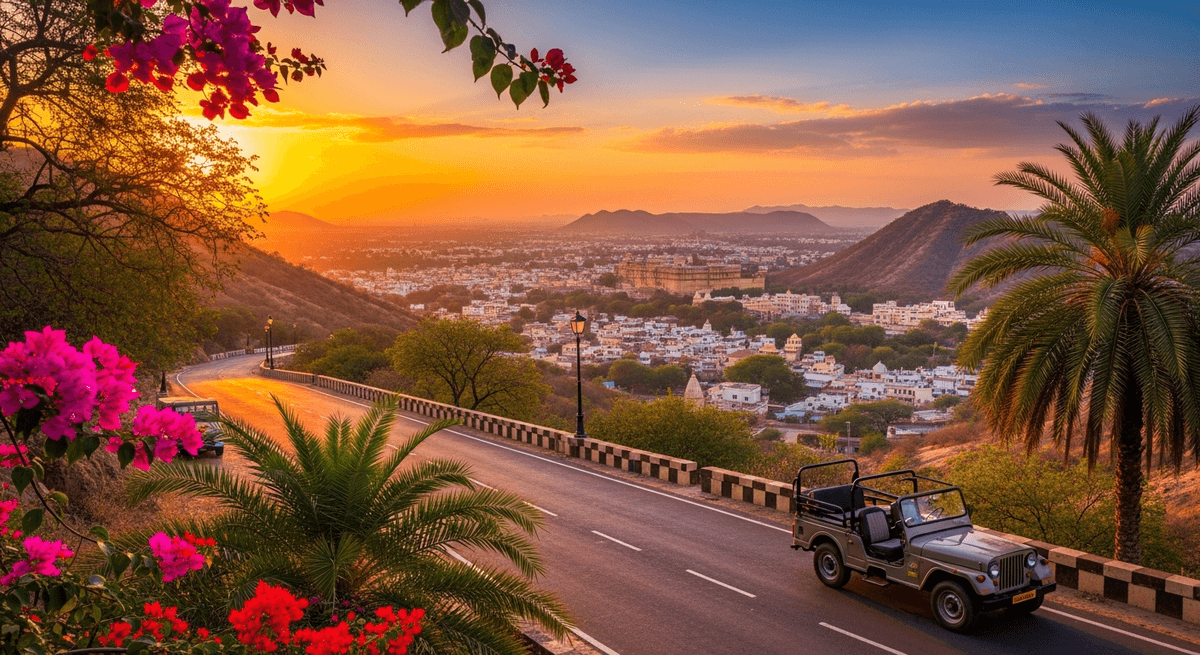
Udaipur operates on a different aesthetic principle from the desert cities, replacing sand and ramparts with water and gardens, creating a landscape where lakes reflect palaces and hills provide backdrops for architecture that treats natural beauty as a collaborator rather than a challenge to overcome. The approach to the city reveals Lake Pichola first, its waters dotted with islands where palaces rise like elaborate boats moored in perpetuity, before the City Palace complex unfolds along the eastern shore in a series of courtyards, balconies, and towers that climb the hillside in carefully orchestrated stages.
The Lake Palace, built on Jag Niwas island in 1746 as a summer retreat for Maharana Jagat Singh II, presents white marble architecture that seems to float on water, its reflection creating double palaces that shimmer with each wave. Now operating as a luxury hotel, it provides the rajasthan road trip with its most romantic image and most expensive dining option, though the view from the City Palace ramparts offers the complete picture without the accommodation tariff.
The City Palace itself, built over 400 years by successive maharanas, creates a museum experience where royal apartments maintain their original furnishings and decorations. The Mor Chowk courtyard displays peacock mosaics in glass and ceramic that celebrate Rajasthan's state bird with appropriate magnificence, while the Manak Mahal houses a collection of crystal furniture commissioned from F&C Osler of Birmingham, demonstrating the global reach of royal shopping lists in the 19th century. The palace's highest terraces provide views across the lake complex that encompass the Monsoon Palace on distant Bansdara Peak, creating landscape compositions that suggest the entire region was designed as a single enormous garden.
Boat trips on Lake Pichola, particularly at sunset, position the Lake Palace and Jag Mandir island palace within the mountain backdrop that makes Udaipur's beauty feel effortless despite the enormous human effort required to create it. The evening aarti ceremony at Jagdish Temple, accompanied by drums and bells that echo across the water, provides spiritual context for architectural grandeur that was always intended to inspire reverence alongside admiration.
Planning Your Royal Progress
The rajasthan road trip demands preparation as thorough as a state visit, beginning with vehicle selection that prioritises comfort over economy for journeys where road conditions vary from excellent highways to desert tracks that challenge both suspension and confidence. A reliable driver familiar with the route proves invaluable for navigating city centres where GPS signals disappear into medieval street layouts and parking spaces appear as mythical as unicorns. Most hotels arrange driver accommodation, solving the logistics of multi day journeys. For travellers seeking equally dramatic mountain experiences after the desert palaces, the Manali to Leh highway offers Himalayan landscapes that provide stunning contrast to Rajasthan's sandy plains.
Budget planning should account for entry fees that reflect the maintenance costs of UNESCO World Heritage sites and privately owned palaces, with combination tickets often providing savings for multiple attractions. Palace hotel dining, while spectacular in setting, commands prices that reflect the exclusivity of eating within royal apartments, though local restaurants in each city offer authentic Rajasthani cuisine at prices that allow budget allocation for palace visits rather than palace meals.
Essential packing includes layers for temperature variations that range from chilly desert mornings to warm afternoon palace explorations, comfortable walking shoes for fort ramparts and cobbled haveli lanes, and camera equipment capable of capturing architecture that challenges the dynamic range of smartphone sensors. Sun protection becomes critical in desert regions where reflection from sandstone walls doubles UV exposure, while water bottles prevent dehydration during extended palace visits where facilities may be limited.
Accommodation booking requires advance planning during peak season (December through February) when palace hotels and heritage properties fill with visitors seeking authentic maharaja experiences. Many former palaces now operate as hotels, offering the opportunity to sleep within the same walls where royal guests once resided, though authentic palace hotels command premium prices that reflect their historical significance and architectural maintenance costs. Travellers planning to explore more of India's diverse landscapes might also consider Spiti Valley's cold desert terrain for a completely different Himalayan desert experience.
GPSSquad's rajasthan road trip planner coordinates the complex timing that transforms a potential logistical nightmare into a seamless royal progress. From securing Amber Fort elephant rides during optimal morning light to arranging Jaisalmer desert camp reservations for clear sky nights, our system handles the advance bookings that separate successful palace hopping from disappointed wandering outside locked gates. The route optimization ensures efficient travel between cities while allowing adequate time for the extended palace visits that Rajasthan's architectural treasures deserve, because rushing through royal apartments defeats the entire purpose of visiting places designed for leisurely appreciation by people who had nothing but time and unlimited decoration budgets. Plan this trip on GPSSquad.